
India and China on Wednesday held 'constructive' and 'forward-looking' diplomatic talks to resolve the over four-year border standoff along the Line of Actual Control (LAC) in eastern Ladakh but there was clear no indication of any breakthrough.

US President Donald Trump has called for an end to the escalating tensions between India and Pakistan, expressing concern over the situation and offering to help resolve the conflict. Trump said he wants to see the two countries "stop" and work it out, adding that he has "good relationships" with both nations. He said he hopes the hostilities will end "very quickly", expressing sadness over the situation.

'Pralay' is a 350-500 km short-range, surface-to-surface missile with a payload capacity of 500-1,000 kg. The solid-fuel, battlefield missile is based on the Prithvi Defence Vehicle.
'Indian Army officers always lead their men into battle or combat. Pakistani officers are seldom seen at the front.'
Foreign ministry spokesman Zhao Lijian, during a media briefing in Beijing, said that China's position on the border related issues is clear and consistent. "We have been following the important consensus reached by the two leaders and strictly observing the agreements between the two countries," he said, apparently referring to the directions of Chinese President Xi Jinping and Prime Minister Narendra Modi after their two informal summits, asking the militaries of the two countries to take more confidence building measures to maintain peace and tranquillity along the borders.
India on Monday announced it has reached an agreement with China on patrolling along the Line of Actual Control (LAC) in eastern Ladakh, in a major breakthrough in ending the over four-year-long military standoff ahead of a likely meeting between Prime Minister Narendra Modi and Chinese President Xi Jinping in Russia this week.

The Chinese Army troops try to enter these areas every year and try to patrol out their claim line which India does not allow.

A village built by China along the Line of Actual Control in the Arunachal Pradesh sector and mentioned in a recent Pentagon report, is in territory controlled by that country, sources in the security establishment in New Delhi said on Tuesday.
Army Chief General Upendra Dwivedi Monday said there is still a 'degree' of standoff between the Indian and Chinese militaries along the Line of Actual Control in eastern Ladakh and both sides need to sit down and firm up a broader understanding on how to calm down the situation.

India and China on Thursday vowed to redouble efforts to resolve the remaining issues in eastern Ladakh at the earliest and 'stabilise and rebuild' ties even as External Affairs Minister S Jaishankar conveyed to his Chinese counterpart Wang Yi during a meeting that the Line of Actual Control (LAC) must be respected.

Chinese Foreign Minister Wang Yi has called on India to implement the consensus reached by Prime Ministers Narendra Modi and Xi Jinping at their summit in Russia, urging a restart of bilateral ties. Wang emphasized the importance of respecting each other's core interests, enhancing mutual trust, handling differences effectively, and bringing the relationship back on track. He suggested practical steps such as resuming flights, easing visa procedures, and planning commemorative activities for the 75th anniversary of diplomatic relations. Wang also highlighted the shared interests and opportunities for cooperation between the two countries, advocating for mutual development and strengthening coordination in international affairs.

The sources have said that patrolling will begin at these points once the disengagement that began last week is completed and both sides will move their respective troops and dismantle temporary structures.

'but the terrorism issue should be fair, square at the centre of the conversation. It is the major issue ... I am not saying there are no other issues. But I am not going to duck that issue for the sake of talking'

India and China have implemented a pact on patrolling in Depsang and Demchok along the Line of Actual Control (LAC) in eastern Ladakh, as per agreed modalities and timelines. The agreement was reached on October 21 and includes provisions for disengagement and patrolling in the last two friction points in the region. The pact has been effected and implemented as agreed, with both sides resuming patrolling activities and grazing, where applicable, as per longstanding practice before the friction began. The terms of the disengagement agreements reached prior to the latest pact continue to hold in relevant areas in eastern Ladakh. The agreement applies mutually to both sides and is without prejudice to India's positions on the LAC or boundary lines. India and China are each carrying out one round of patrolling in Depsang and Demchok, but they have maintained their deployment of troops along the LAC. The focus now is on de-escalation of the overall situation. The agreement was endorsed by Prime Minister Narendra Modi and Chinese President Xi Jinping in a meeting in Kazan, Russia, signaling attempts to normalize ties.

In a year bookended by intractable conflicts and geopolitical fragmentation, India focused on ramping up military prowess by broadly firming up defence procurement worth Rs 4.22 lakh crore even as Indian and Chinese militaries completed pulling back their troops from border face-off points in eastern Ladakh.

India and the United States have announced a groundbreaking 10-year defence partnership, paving the way for increased military cooperation and potential sales of F-35 stealth fighter jets. The agreement aims to bolster both countries' defence capabilities in the Indo-Pacific region, with plans for joint production of weapons and platforms. The move comes amid China's growing military presence in the region.
'China is playing the big global game.' 'Their ambitions lie far beyond the Line of Actual Control.'
He said that the two nations will have issues in the foreseeable future. However, there are ways of addressing those issues and what happened in 2020 was not the way to address those issues.
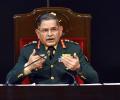
The General said it was "too early" to take a call on the role of Bangladesh, where a change in government may bring about a change in the relationship between it and India.
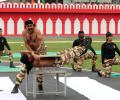
The 62nd Raising Day of the Indo-Tibetan Border Police Force was commemorated with great enthusiasm at the Seema Dwar in Dehradun.

Kannappa is a bloated mess of a film that underutilises interesting story ideas, observes Arjun Menon.

The exchange took place at five Border Personnel Meeting points along the LAC, the sources added.

The Bombay High Court acquitted all 12 accused in the 2006 Mumbai train blasts case, citing a failure by the prosecution to prove their guilt and raising serious concerns about the investigation and evidence presented.

"The Modi government's approach to the entire crisis could be described as DDLJ: Deny, Distract, Lie and Justify," Ramesh said.

'All governments are scared of a negative image.' 'Somehow, this government has a tendency to create a narrative that things are improving.' 'When the real data gives a different picture, they are upset.'

External Affairs Minister S Jaishankar on Saturday credited the breakthrough agreement with China on patrolling along the Line of Actual Control to the military which worked in 'very very unimaginable' conditions and deft diplomacy.

Talking about the expectations from India, Jaishankar said that there are lots of expectations as New Delhi is seen as the one that solves problems.
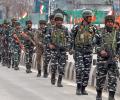
When the internal security situation spirals out of the control of the provincial law and order machinery, the CAPFs can be called in, providing a security buffer before the Army is deployed.
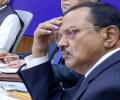
National Security Advisor Ajit Doval arrived in Beijing on Tuesday to take part in the India-China Special Representatives' talks to be held on Wednesday aimed at restoring the bilateral ties stalled for over four years' due to the military standoff in eastern Ladakh.
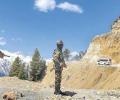
China and India have agreed to work to maintain peace along the Line of Actual Control and resolve the border standoff through talks while implementing the consensus reached between the two countries' leadership that 'differences' do not escalate into 'disputes', a top Chinese official said.
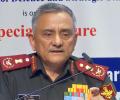
Pakistan's decision to talk to India on May 10 stemmed from realisation that it will suffer more if its operation continues, Gen Chauhan said.
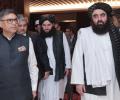
India's Foreign Secretary Vikram Misri has arrived in Beijing for a two-day visit during which he will hold talks with Chinese officials. The visit comes amid ongoing efforts to de-escalate tensions along the Line of Actual Control (LAC) in eastern Ladakh and to resume bilateral cooperation in various fields, including the Kailash Mansarovar Yatra.
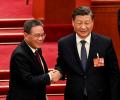
'The real issue between India and China is that the Chinese have transgressed along the Line of Actual Control at multiple points.'
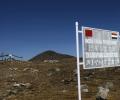
The resolution also pushes back against People's Republic of China (PRC) claims that Arunachal Pradesh is PRC territory, which is a part of the PRC's increasingly aggressive and expansionist policies.

Gen Dwivedi, who has vast operational experience along the frontiers with China and Pakistan, was serving as the Vice Chief of the Army.

'Pakistan's only concern has been while they were on the FATF watch list was to distance their State institutions and organs from any direct connection with the actual execution of militancy inside Kashmir.'

Even though both situations -- with their symptoms of detachment and fatigue -- may occur at the same time, the causes for both are quite different. Which means they need to be approached differently, points out Shruti Swaroop, founder, Embrace Consulting and co-founder, International Inclusion Alliance.
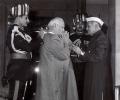
Vice President V V Giri's resignation in 1969 triggered political upheavals that saw the ruling party defy its own presidential nominee, the expulsion of a sitting prime minister by her party president, and a historic split in the Indian National Congress, recounts Utkarsh Mishra.
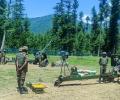
India fully utilised its military modernisation budget in 2024-2025 -- the first time in five years -- and signed a record Rs 2 trillion defence contracts.

After the Chinese People's Liberation Army troop buildup at the Line of Actual Control, the border separating India and China, the Indian Army has beefed up the 1,300 km-long LAC in the eastern sector in Tawang, Arunachal Pradesh.
